The Perseid meteor shower is peaking this weekend as Earth passes through a stream of debris from Comet Swift-Tuttle. Observers from the International Meteor Organization report rates as high as 60 Perseids per hour. That sounds like a good show; in fact, bright moonlight is making many of the meteors difficult to see. Casual observers are experiencing an off-year for the Perseids.
Moonlight was no problem for Stan Nelson of Roswell, New Mexico, who spent peak-night listening to the shower. Nelson monitors the US Air Force Space Surveillance Radar in Texas for echoes of meteors passing over the facility. He recorded this specimen ping at 9:30 am MDT on Aug. 13th.
duminică, 14 august 2011

marți, 28 iunie 2011
duminică, 22 mai 2011
Super Storm on Saturn
May 19, 2011: NASA's Cassini spacecraft and a European Southern Observatory ground-based telescope are tracking the growth of a giant early-spring storm in Saturn's northern hemisphere so powerful that it stretches around the entire planet. The rare storm has been wreaking havoc for months and shooting plumes of gas high into the planet's atmosphere.
 "Nothing on Earth comes close to this powerful storm," says Leigh Fletcher, a Cassini team scientist at the University of Oxford in the United Kingdom, and lead author of a study that appeared in this week's edition of Science Magazine. "A storm like this is rare. This is only the sixth one to be recorded since 1876, and the last was way back in 1990."
Cassini's radio and plasma wave science instrument first detected the large disturbance in December 2010, and amateur astronomers have been watching it ever since through backyard telescopes. As it rapidly expanded, the storm's core developed into a giant, powerful thunderstorm, producing a 3,000-mile-wide (5,000-kilometer-wide) dark vortex possibly similar to Jupiter's Great Red Spot.
This is the first major storm on Saturn observed by an orbiting spacecraft and studied at thermal infrared wavelengths. Infrared observations are key because heat tells researchers a great deal about conditions inside the storm, including temperatures, winds, and atmospheric composition. Temperature data were provided by the Very Large Telescope (VLT) on Cerro Paranal in Chile and Cassini's composite infrared spectrometer (CIRS), operated by NASA's Goddard Space Flight Center in Greenbelt, Md.
"Our new observations show that the storm had a major effect on the atmosphere, transporting energy and material over great distances -- creating meandering jet streams and forming giant vortices -- and disrupting Saturn's seasonal [weather patterns]," said Glenn Orton, a paper co-author, based at NASA's Jet Propulsion Laboratory in Pasadena, Calif.
The violence of the storm -- the strongest disturbances ever detected in Saturn's stratosphere -- took researchers by surprise. What started as an ordinary disturbance deep in Saturn's atmosphere punched through the planet's serene cloud cover to roil the high layer known as the stratosphere.
This false-color infrared image shows clouds of large ammonia ice particles dredged up by the powerful storm. Credit: Cassini. [more]
Cassini's radio and plasma wave science instrument first detected the large disturbance in December 2010, and amateur astronomers have been watching it ever since through backyard telescopes. As it rapidly expanded, the storm's core developed into a giant, powerful thunderstorm, producing a 3,000-mile-wide (5,000-kilometer-wide) dark vortex possibly similar to Jupiter's Great Red Spot.
This is the first major storm on Saturn observed by an orbiting spacecraft and studied at thermal infrared wavelengths. Infrared observations are key because heat tells researchers a great deal about conditions inside the storm, including temperatures, winds, and atmospheric composition. Temperature data were provided by the Very Large Telescope (VLT) on Cerro Paranal in Chile and Cassini's composite infrared spectrometer (CIRS), operated by NASA's Goddard Space Flight Center in Greenbelt, Md.
"Our new observations show that the storm had a major effect on the atmosphere, transporting energy and material over great distances -- creating meandering jet streams and forming giant vortices -- and disrupting Saturn's seasonal [weather patterns]," said Glenn Orton, a paper co-author, based at NASA's Jet Propulsion Laboratory in Pasadena, Calif.
The violence of the storm -- the strongest disturbances ever detected in Saturn's stratosphere -- took researchers by surprise. What started as an ordinary disturbance deep in Saturn's atmosphere punched through the planet's serene cloud cover to roil the high layer known as the stratosphere.

joi, 24 martie 2011

joi, 17 februarie 2011
joi, 6 ianuarie 2011
Filme la maximum eclipsei din 4 januarie 2011
Pun inca odata filmele, separat de poze de data asta. A se vedea postarile anteioare.
Atentie, ora care apere setata pe aparat e 2010 (din inertie)!
Atentie, ora care apere setata pe aparat e 2010 (din inertie)!
marți, 4 ianuarie 2011
Poze - eclipsa de Soare din 4 ianuarie 2011
Cateva poze si filme (facute cu un aparat foto oarecare). Data e 2011.01.04, evident si nu 2010, cum gresit a fost setat aparatul. E evident pentru simplul fapt ca pe 4 ianuarie 2010 nu a fost nici o eclipsa.


Si doua filme facute in jurul momentului de maxim.


Si doua filme facute in jurul momentului de maxim.
sâmbătă, 1 ianuarie 2011
Eclipsa de Soare din 4 ianuarie 2011
Prima eclipsă de soare a anului 2011 are loc la nodul ascendent al Lunii in Sagetator est. O eclipsa partiala va fi vizibila in mare parte din Europa, Africa de Nord şi Asia Centrală.
Penumbra atinge suprafata Pamantului intai in nordul Algeriei, la 06:40:11 UT. Europa de Vest va fi sub o eclipsa partiala de la răsăritul soarelui. Eclipsa va avea amploarea urmatoare in oraşele europene: Madrid (0.576), Paris (0.732), Londra (0.747), şi Copenhaga (0.826).
Cea mai mare eclipsa apare la 08:50:35 UT in nordul Suediei, unde la orizont va avea o magnitudine de 0.858. La acel moment, axa umbrei Lunii va trece doar 510 km deasupra suprafetei Pamantului. Cele mai multe din nordul Africii, Orientul Mijlociu şi Asia Centrală se află, de asemenea, în calea lui penumbrei astfel: Cairo (0.551), Ierusalim (0.574), Istanbul (0.713), şi Teheran (0.507).
Un apus de soare in eclipsa va fi vizibil din centrul Rusiei, Kazahstan, Mongolia şi nord-vestul Chinei. Eclipsa partiala se termină la 11:00:54 UT.
La Bucuresti, eclipsa partiala incepe la 09:08:11 , are faza maxima la 10:35:28 , si se incheie la 12:08:58 (timp local). Eclipsa va avea magnitudinea 0.753 la Bucuresti.
Urmatoarea eclipsa de Soare (partiala) vizibila la Bucuresti va fi pe 20 martie 2015.
Aceasta eclipsa face parte din ciclul Saros 151. Eclipsele din Saros 151 au loc toate la nodul ascendent al Lunii şi Luna se mişcă spre sud cu fiecare eclipsa. Seria a început cu o eclipsa partiala in emisfera nordica pe 14 august 1776. Seria se va încheia cu o eclipsa partiala in emisfera sudica pe 01 octombrie 3056. Durata totală a seriei Saros 151 este de 1280.14 ani.
Poza de mai jos este a inelului de diamant de la eclipsa totala de Soare din 29 martie 2006, din Turcia. In Romania a fost eclipsa partiana de Soare.

Penumbra atinge suprafata Pamantului intai in nordul Algeriei, la 06:40:11 UT. Europa de Vest va fi sub o eclipsa partiala de la răsăritul soarelui. Eclipsa va avea amploarea urmatoare in oraşele europene: Madrid (0.576), Paris (0.732), Londra (0.747), şi Copenhaga (0.826).
Cea mai mare eclipsa apare la 08:50:35 UT in nordul Suediei, unde la orizont va avea o magnitudine de 0.858. La acel moment, axa umbrei Lunii va trece doar 510 km deasupra suprafetei Pamantului. Cele mai multe din nordul Africii, Orientul Mijlociu şi Asia Centrală se află, de asemenea, în calea lui penumbrei astfel: Cairo (0.551), Ierusalim (0.574), Istanbul (0.713), şi Teheran (0.507).
Un apus de soare in eclipsa va fi vizibil din centrul Rusiei, Kazahstan, Mongolia şi nord-vestul Chinei. Eclipsa partiala se termină la 11:00:54 UT.
La Bucuresti, eclipsa partiala incepe la 09:08:11 , are faza maxima la 10:35:28 , si se incheie la 12:08:58 (timp local). Eclipsa va avea magnitudinea 0.753 la Bucuresti.
Urmatoarea eclipsa de Soare (partiala) vizibila la Bucuresti va fi pe 20 martie 2015.
Aceasta eclipsa face parte din ciclul Saros 151. Eclipsele din Saros 151 au loc toate la nodul ascendent al Lunii şi Luna se mişcă spre sud cu fiecare eclipsa. Seria a început cu o eclipsa partiala in emisfera nordica pe 14 august 1776. Seria se va încheia cu o eclipsa partiala in emisfera sudica pe 01 octombrie 3056. Durata totală a seriei Saros 151 este de 1280.14 ani.
Poza de mai jos este a inelului de diamant de la eclipsa totala de Soare din 29 martie 2006, din Turcia. In Romania a fost eclipsa partiana de Soare.

luni, 8 noiembrie 2010
Cometa IKEYA-MURAKAMI
Nou descoperita cometa C/2010 V1 (Ikeya-Murakami) ofera un spectacol bun pentru oricine are un telescop, o curte şi un ceas cu alarmă. Ceasul este pentru a va trezi înainte de zori, şi telescopul este pentru a o vedea, in aproprierea lui Saturn.

Leonid Elenin a obtinut aceasta fotografie cu un telescop robotic in New Mexico.
Leonid Elenin a obtinut aceasta fotografie cu un telescop robotic in New Mexico.
sâmbătă, 6 noiembrie 2010
ACTIVE SUNSPOT
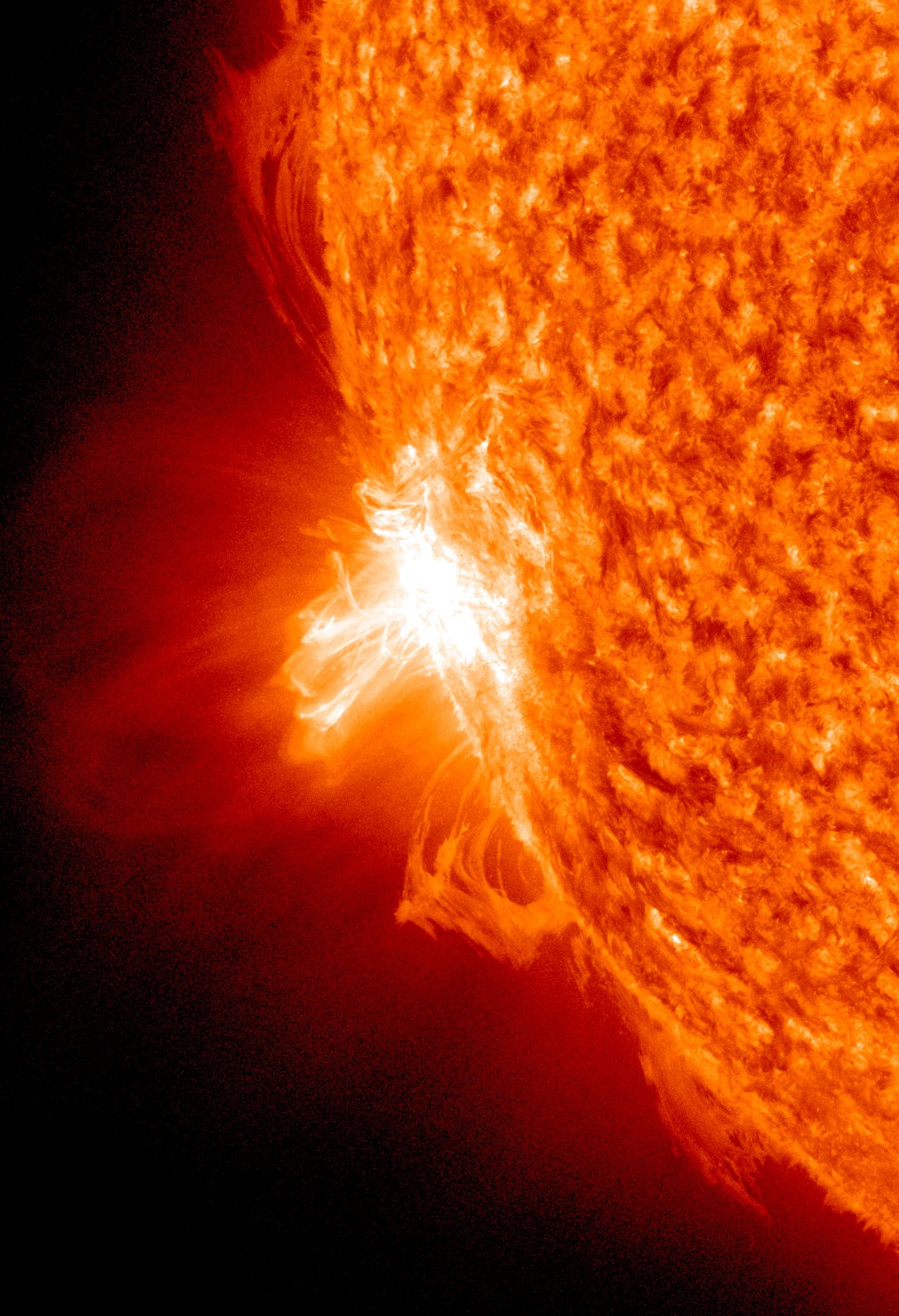
NOAA forecasters say there is a 70% chance of M-class solar flares during the next 24 hours. The source of the blast would be active region 1121 emerging over the sun's eastern limb:
Indeed, AR1121 is already crackling with an M2-flare on Nov. 4th and an M1-flare on Nov. 5th. So far none of the flares has been geo-effective, but this could change as the sun's rotation turns the blast site toward Earth in the days ahead. Readers with solar telescopes are encouraged to monitor developments.
Indeed, AR1121 is already crackling with an M2-flare on Nov. 4th and an M1-flare on Nov. 5th. So far none of the flares has been geo-effective, but this could change as the sun's rotation turns the blast site toward Earth in the days ahead. Readers with solar telescopes are encouraged to monitor developments.
joi, 4 noiembrie 2010
Comet Hartley 2's nucleus
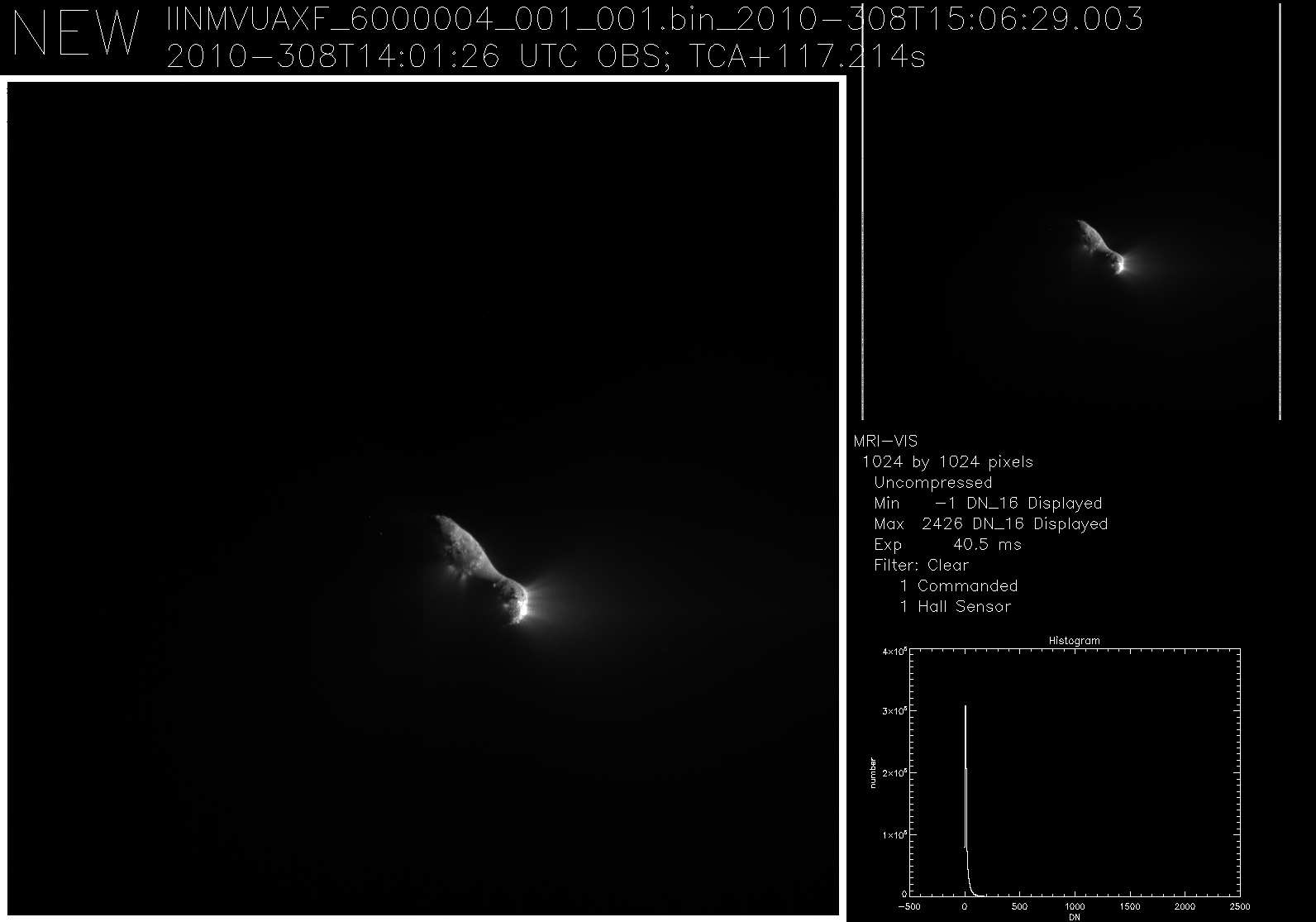
COMET ENCOUNTER UPDATE: NASA's Deep Impact (EPOXI) probe has just completed its 435 mile flyby of Comet Hartley 2's nucleus. The spacecraft has turned its high-gain antenna toward Earth and data are being transmitted to mission control at JPL. The first raw images have just arrived and, even without processing, they are spectacular:
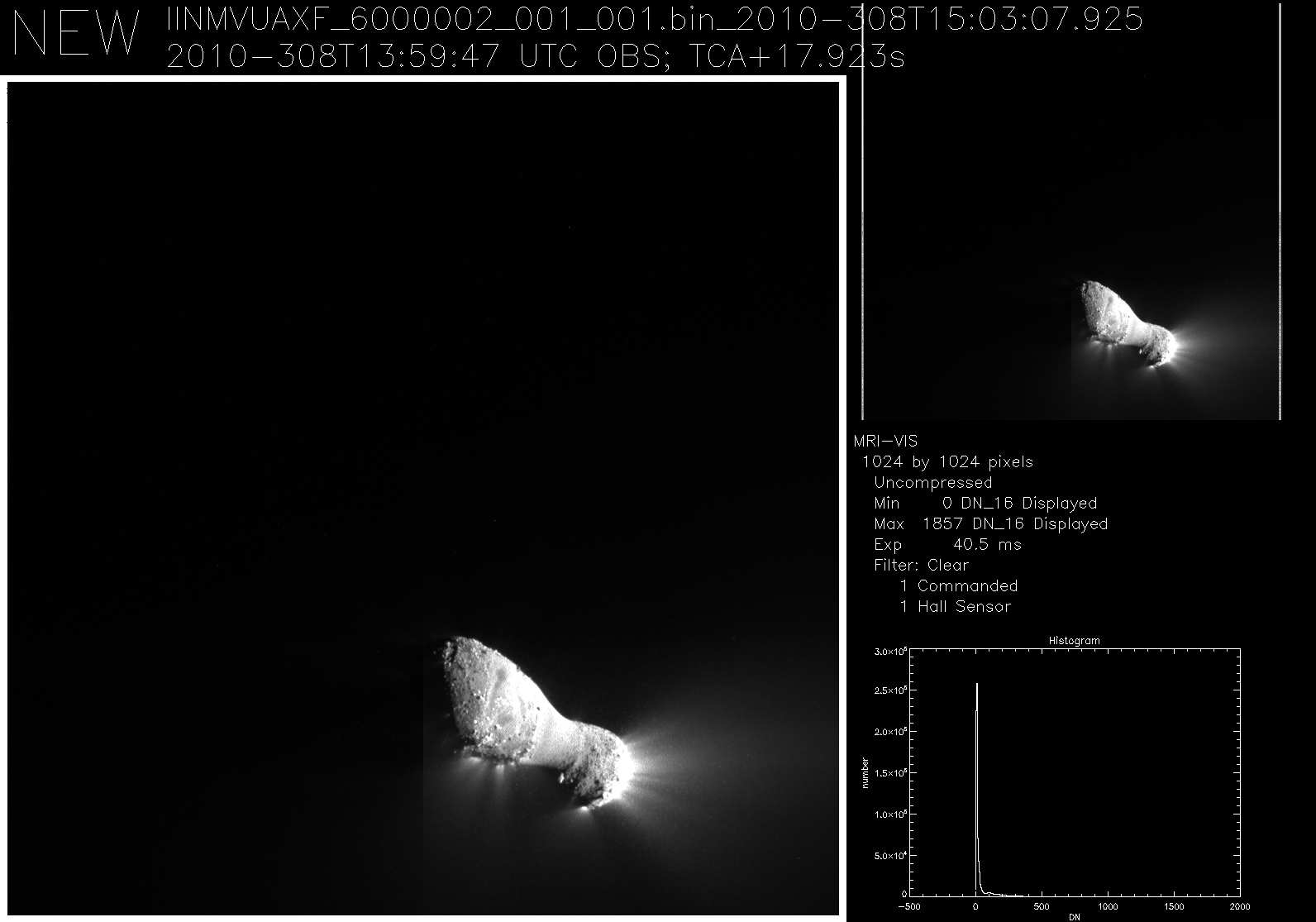
A press conference will be held this afternoon at 4 pm EDT to discuss the results and to reveal even higher-resolution images. Tune into NASA TV to follow events live.
vineri, 29 octombrie 2010
Soarele, steaua de langa noi
Trăim în atmosfera extinsă a unei stele active. Aici am trăit mereu, dar acum începem să conştientizăm. Este provocarea omului modern de a întelege la o altă dimensiune natura şi universul. Dacă în 1957 omenirea pornea spre cucerirea spaţiului cosmic şi începea să îşi privească planeta de sus pentru a o cunoaşte mai bine, în zilele noastre orizontul cunoaşterii s-a schimbat la graniţele heliosferei şi spre galaxie.
Heliosfera reprezintă zona de influenţă a Soarelui şi a vântului solar. Ea are forma unei bule uriaşe ce se întinde până aproape de centura lui Kuiper şi a cărei structuri exterioare (heliopauza) este determinată de actiunea vânturilor galactice şi a vântului solar supersonic, ce îşi încetineşte viteza dincolo de orbita planetei Neptun. La graniţa heliosferei se află heliopauza, ce se întinde probabil la 100 UA (unitaţi astronomice) de la Soare. Forma exactă şi distanţa până la heliopauză nu sunt încă bine cunoscute. Câteva staţii spaţiale (Pioneer 10 şi 11, Voyager 1 şi 2) sunt în drum spre această zonă. Voyager 1 şi Voyager 2 au părăsit zona de acţiune a vântului solar supersonic la aproximativ 85 UA şi au intrat în heliopauză. Satelitul IBEX (Interstellar Boundary Explorer), lansat în 2008, a găsit ceva necunoscut până acum, o bandă de atomi neutrii încărcaţi energetic ce par a fi rezultatul interacţiunii heliosferei cu galaxia. Aşa cum şi staţia Cassini a relevant, înteracţiunea dintre heliosferă şi galaxie pare a fi controlată de presiunea particolelor şi densitatea de energie a câmpului magnetic.

Motorul activităţii solare este prin excelenţă magnetic. Magnetismul solar se formează prin acţiunea dinamo în tahoclină, stratul de tranziţie dintre două regiuni cu regimuri distincte de rotaţie, interiorul solar cu rotaţie aproape rigidă şi zona convectivă cu rotaţie diferenţială. Câmpul magnetic bipolar general al Soarelui este purtat în spaţiu de către vântul solar. Datorită rotaţiei diferenţiale a straturilor atmosferei solare cât şi a zonei convective (zona de deasupra tahoclinei), stratul de curent determinat de polarităţile opuse ale câmpului magnetic general al Soarelui (neutru din punct de vedere magnetic) este deformat astfel că spaţiul interplanetar apare cu zone sectoriale din punct de vedere magnetic. Structura tridimensională a acestuia are aspectul fustei unei balerine care face o piruetă. Figura 2 schiţează o secţiune a câmpului magnetic interplanetar şi orbita Pământului: se observă zone cu linii de câmp magnetic ce pleacă de la Soare şi zone cu linii orintate spre Soare, despărţite de graniţe sectoriale (straturi de curenţi).

Această structură sectorială a spaţiului interplanetar reprezintă o primă consecinţă a magnetismului solar. Insă lucrurile trebuie privite în mod dinamic, ţinând cont de ciclicitatea activităţii solare care este marcată din aproximativ 11 în 11 ani de inversarea polilor magnetici ai astrului. Activitatea solară constă în apariţia mai multor fenomene în atmosfera Soarelui, ca manifestare a magnetismului astrului, fenomene ca petele solare, erupţiile, protuberanţele, ejecţiile de masă, găurile coronale, curenţii coronali, s.a. Cea mai lungă serie temporală de observaţii astronomice se referă la grupurile de pete solare, ca manifestare a regiunilor active, astfel că marcarea ciclurilor solare este legată de seria numărului relativ de pete (numărul Wolf). La minim solar (număr minim de pete) există mai puţine zone sectoriale în spaţiu (două), dar acestea se înmulţesc odată cu înaintarea în ciclul solar.
Spaţiul interplanetar este deci modelat de magnetismul solar ce este purtat spre graniţele heliosferei de către vântul solar. Pe parcursul ciclului solar de 11 ani, de la minim spre maxim, fenomenele active se înmulţesc şi astfel şi spaţiul interplanetar devine subiectul acţiunii solare. Atunci când ejecţii coronale de masă se suprapun peste vântul solar ele domină condiţiile fizice din spaţiu, astfel putem vorbi de vremea spaţială (space wather). Termenul de vreme spaţială se referă la condiţiile de pe Soare şi din vântul solar, magnetosferele planetare, ionosfera şi termosfera, care pot influenţa performanţele sau integritatea sondelor spaţiale sau a sistemelor tehnologice terestre şi pot afecta viaţa şi activitatea umană, cât şi sănătatea, confom definiţiei date de Planul National de Vreme Spaţială al Statelor Unite.
vineri, 16 octombrie 2009
GIANT RIBBON DISCOVERED AT THE EDGE OF THE SOLAR SYSTEM
For years, researchers have known that the solar system is surrounded by a vast bubble of magnetism. Called the "heliosphere," it springs from the sun and extends far beyond the orbit of Pluto, providing a first line of defense against cosmic rays and interstellar clouds that try to enter our local space. Although the heliosphere is huge and literally fills the sky, it emits no light and no one has actually seen it. Until now.
NASA's IBEX (Interstellar Boundary Explorer) spacecraft has made the first all-sky map of the heliosphere and the results have taken researchers by surprise. The map is bisected by a bright, winding ribbon of unknown origin:

"This is a shocking new result," says IBEX principal investigator Dave McComas of the Southwest Research Institute. "We had no idea this ribbon existed--or what has created it. Our previous ideas about the outer heliosphere are going to have to be revised."
The two Voyager spacecraft (labeled V1 and V2 in the figure) have spent decades traveling to the edge of the solar system for in situ inspection of whatever might be there--but ironically both spacecraft missed the ribbon. "It's like having two weather stations, but missing the big storm that runs between them," says Eric Christian, IBEX deputy mission scientist at NASA's Goddard Space Flight Center.
At the moment, theorists are "working like crazy" to understand this discovery and how the ribbon might effect the ability of the heliosphere to shield us from cosmic rays. Science@NASA has the full story.
vineri, 25 septembrie 2009
SOLAR FLARE:
New-cycle sunspot 1026 is crackling with magnetic activity, and this morning it produced a C-class solar flare. The Solar and Heliospheric Observatory's (SOHO's) extreme UV telescope recorded the action around 0100 UT on Sept. 25th:
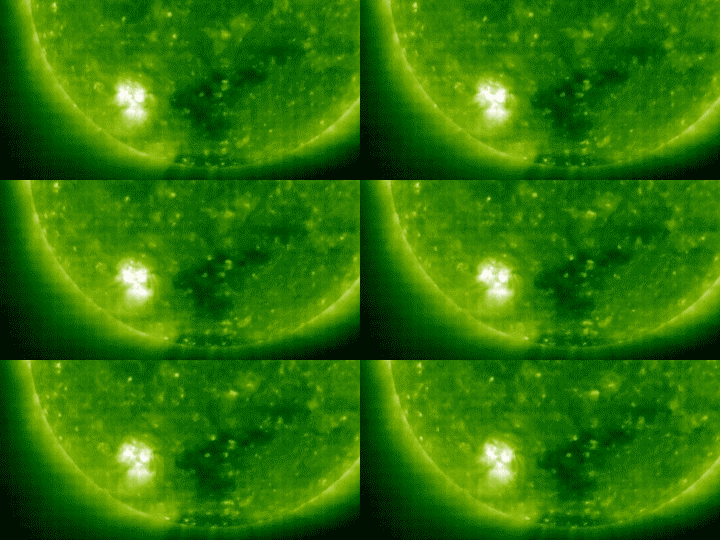
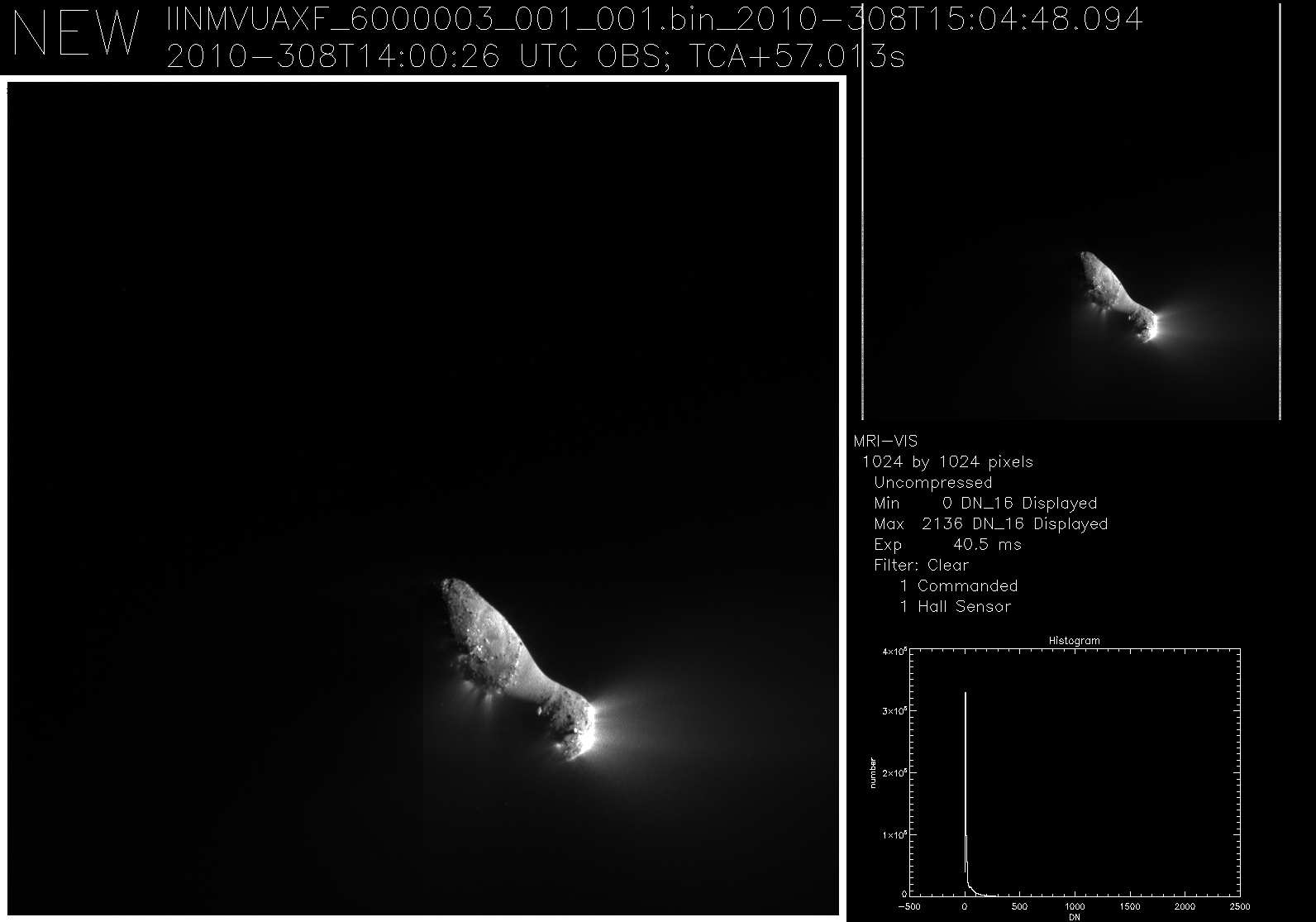
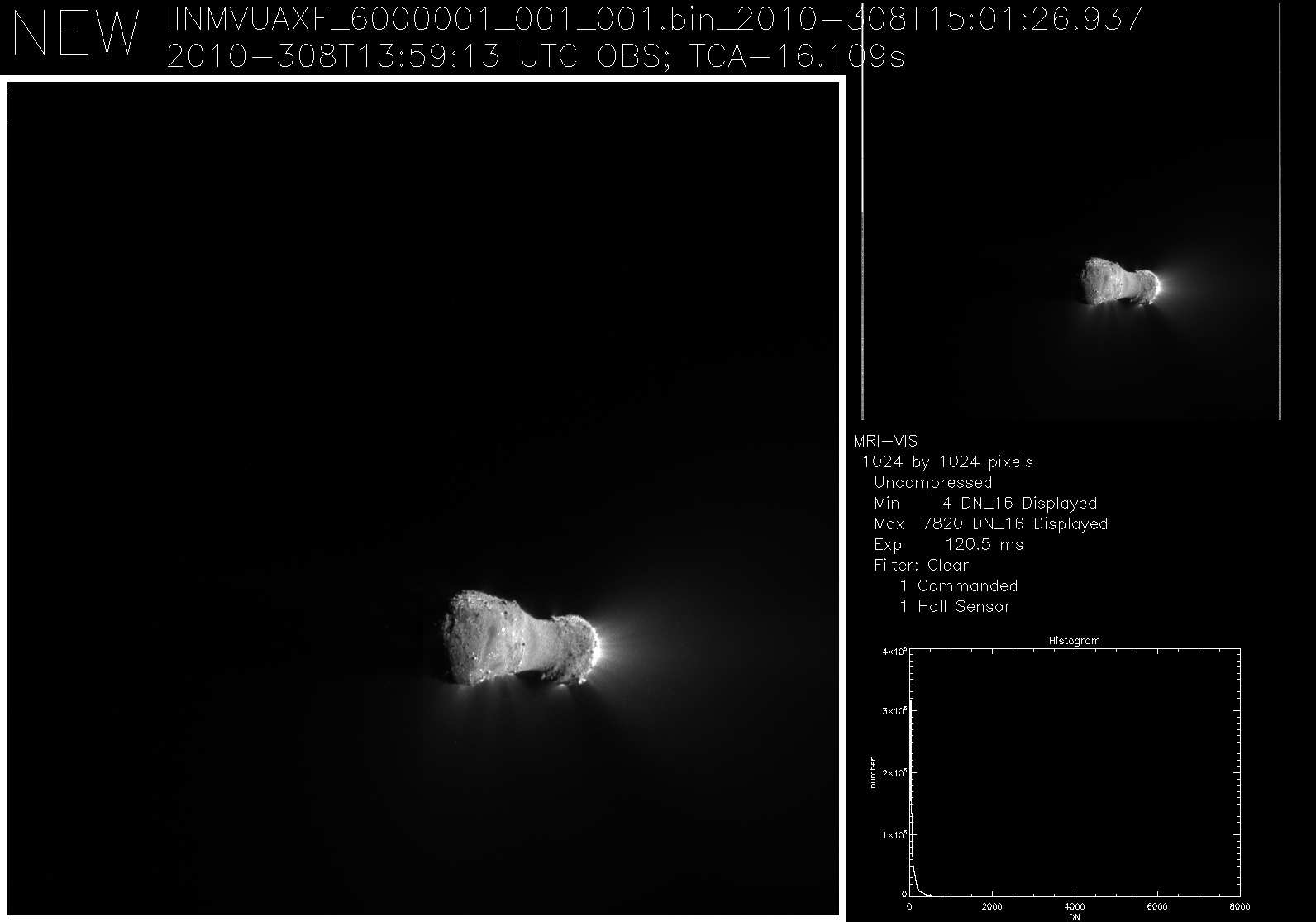
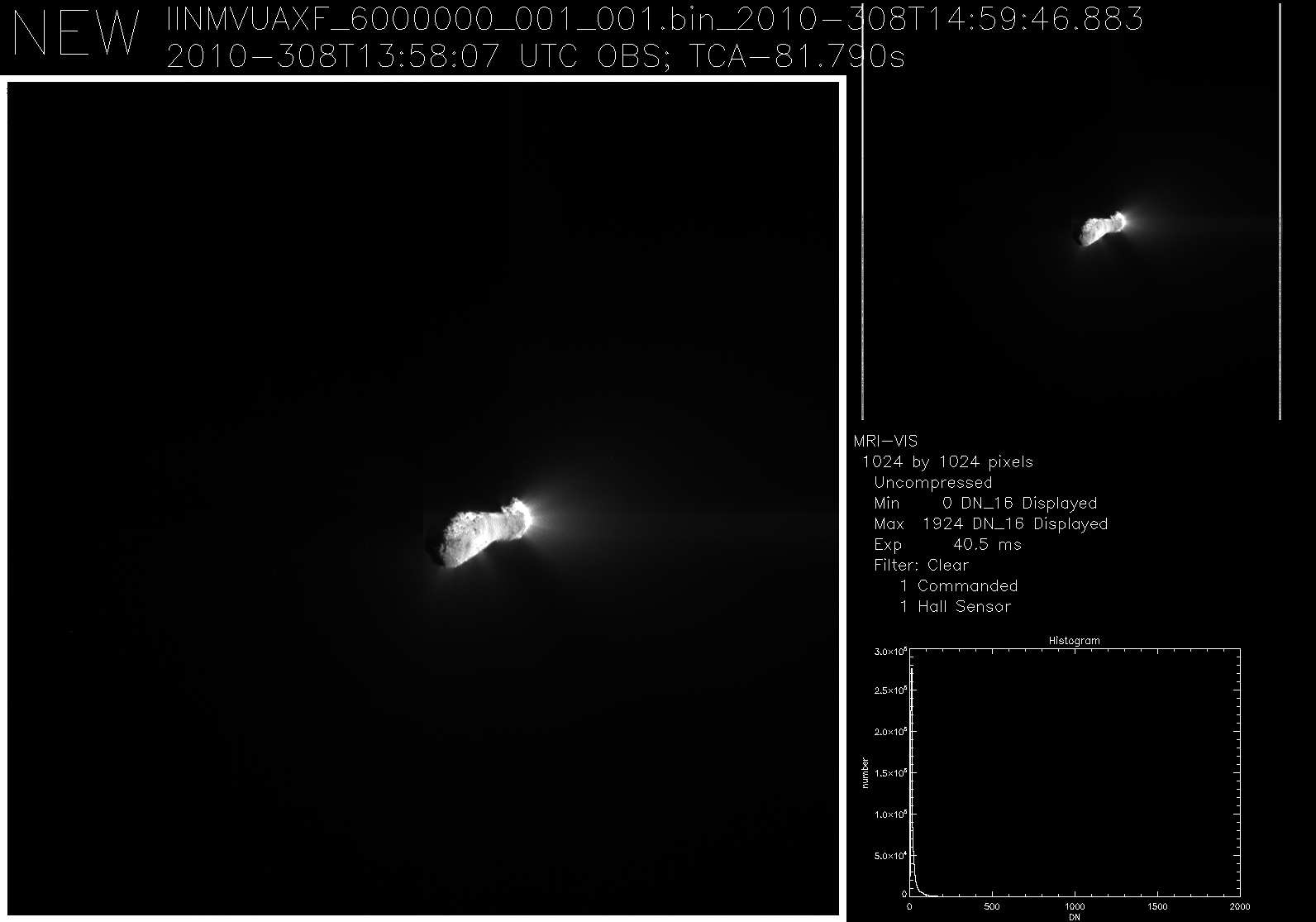
If you thought that flare seemed small, you were right. It was about 100-times too weak too affect Earth. During Solar Maximum, such a minor eruption would probably go unnoticed and certainly unmentioned. But during the deepest solar minimum in almost 100 years, it's a big event. A C-flare! The blast raised no radio blackouts or radiation storms--only the hopes of solar observers for something more flamboyant. Stay tuned.
sâmbătă, 5 septembrie 2009
SOLAR MINIMUM VS. GLOBAL WARMING
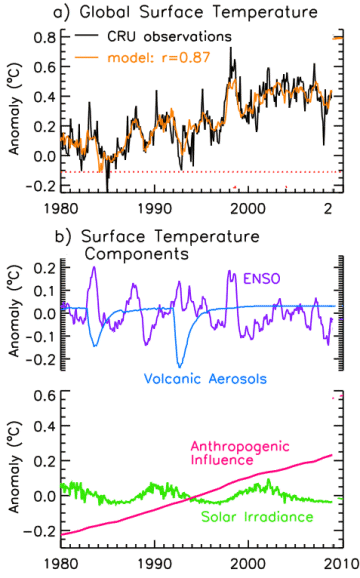
From 2002 to 2008, decreasing solar irradiance has countered much anthropogenic warming of Earth's surface. That's the conclusion of researchers Judith Lean (NRL) and David Rind (NASA/GISS), who have just published a new analysis of global temperatures in the Geophysical Research Letters. Lean and Rind considered four drivers of climate change: solar activity, volcanic eruptions, ENSO (El Nino), and the accumulation of greenhouse gases. The following plot shows how much each has contributed to the changing temperature of Earth's surface since 1980:
Volcanic aerosols are a source of cooling; ENSO and greenhouse gases cause heating; the solar cycle can go either way. When added together, these factors can account for 76% of the variance in Earth's surface temperature over the past ~30 years, according to the analysis of Lean and Rind.
Several aspects of their model attract attention: "The warmest year on record, 1998, coincides with the 'super-El Nino' of 1997-98," points out Lean. "The ESNO is capable of producing significant spikes in the temperature record." Solar minimum has the opposite effect: "A 0.1% decrease in the sun's irradiance has counteracted some of the warming action of greenhouse gases from 2002 - 2008," she notes. "This is the reason for the well-known 'flat' temperature trend of recent years."
What's next? Ultimately, the authors say, temperatures will begin rising again as greenhouse gases accumulate and solar activity resumes with the coming of the next solar cycle. Of couse, the solar cycle could be out of whack; if solar minimum deepens and persists, no one is certain what will happen. Lean and Rind reveal their predictions for the future here.
Reference: Lean, J. L., and D. H. Rind (2009), How will Earth's surface temperature change in future decades?, Geophys. Res. Lett., 36, L15708
(Source: www.spaceweather.com)
marți, 28 aprilie 2009
Nivelul actual al activitatii solare

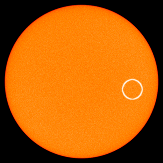
Nivelul actual al activitatii solare este scazut. O regiune mica de flux magnetic a aparut la suprafata vizibila in partea de SV a Soarelui, in ultimele doua zile. Regiunea contine doua pete noi formate si cateva bucle coronale vizibile in EUV. Pozitia aproximativa a regiunii este S08W45, ( 669", -81" ) pe 28 aprilie 2009, ora 10:00 UT.
joi, 15 ianuarie 2009
Eclipsa inelara de Soare

Prima eclipsa din anul 2009 este o eclipsa inelara de Soare. Aceasta este vizibila, ca eclipsa inelara, in Oceanul Indian, din sudul Africii si pana in vestul Indoneziei, pe un coridor lat de 363 km. Eclipsa este vizibila ca partiala in Madagascar, Australia, sud estul Indiei, sudul Asiei si Indonezia.
Eclipsa inelara incepe in sudul Africii la 06:06 UT. Maximul eclipsei (de 0,9282) se situeaza in Oceanul Indian la 07:58:39 UT si tine 7 minute 54 secunde.
Aceasta eclipsa este al 50-lea membru al ciclului Saros 131, ciclul inceput pe 1 Aug 1125 si va tine 18 Jun 2243.
joi, 6 noiembrie 2008
Heliosfera

Heliosfera reprezintă un spaţiu de influenţă a Soarelui din punct de vedere magnetic, cât şi al activităţii sale manifestată prin vântul solar. Heliosfera are forma unei picaturi {bubble) ce pluteşte în spaţiul interstelar. Atomi neutri din punct de vedere electric, ce vin din mediul interstelar, penetrează heliosfera interacţionând cu aceasta, astfel că există un permanent schimb de materie intre aceasta şi restul Galaxiei.
Văntul solar mătură heliosfera cu o viteză ce poate atinge un milion km/h pe primele 10 miliarde de km pornind radial de la Soare, pentru ca apoi sa îşi încetinească viteza până la epuizare. Zona unde vântul solar înceteaza se numeşte şocul terminal. Zona unde vântul solar şi vântul galactic se echilibrează se numeşte heliopauză. Zona unde influenţa mediului stelar începe să domine asupra vântului solar poartă numele de ‘bow shock’, ceea ce am putea traduce prin front de şoc.
Vântul solar constă într-un flux de particule, atomi ionizaţi şi câmp electromagnetic, flux ce este expulzat de atmosfera solară în spaţiul interplanetar. Datorită rotaţiei diferenţiale a Soarelui, câmpul magnetic transportat de vântul solar ia forma unei spirale tridimensionale, denumită de Parker ‘balerina’, fiind asemanatoare cu jupa unei balerine care se roteşte. Spaţiul interplanetary este împărţit în 2 până la 4 (funcţie de ciclul solar) sectoare magnetice. Aceste sectoare sunt despărţite de graniţe neuter din punct d evedere magnetic, graniţe ce reprezintă de fapt extensia straturilor de current din atmosfera Soarelui. Această structura domină heliosfera interioară.
Structura heliosferei externe este determinată de interactiunea vântului solar cu cel interstelar.
marți, 21 octombrie 2008
Noutati despre activitatea Soarelui
Soarele se afla la perioada de minim al activitatii sale. La sfarsitul lunii trecute si anume, pe 21 septembrie a aparut o pata solara denumita NOAA 11001.Pe 23 Septembrie, a aparut o alta pata solara denumita NOAA 11002. Ea a putut fi observata pentru aproape 3 zile.
Pe 4 octombrie si-a mai facut aparitia inca o pata (NOAA 11003) cu o durata de viata asemanatoare celei precedente. Pe 10 octombrie isi face aparitia NOAA 11004, iar pe 11 - NOAA 11005.
Reamintim ca pata NOAA 11000 si-a facut aparitia pe 18 iulie, ca ultima pata a ciclului solar 23.
Astfel numarul de pete solare incepe sa varieze putin de la valoarea 0.
Pe 4 octombrie si-a mai facut aparitia inca o pata (NOAA 11003) cu o durata de viata asemanatoare celei precedente. Pe 10 octombrie isi face aparitia NOAA 11004, iar pe 11 - NOAA 11005.
Reamintim ca pata NOAA 11000 si-a facut aparitia pe 18 iulie, ca ultima pata a ciclului solar 23.
Astfel numarul de pete solare incepe sa varieze putin de la valoarea 0.
Abonați-vă la:
Postări (Atom)